
The shift to agentic transactions
Solana is rapidly evolving from a high-throughput blockchain into the primary settlement layer for autonomous AI agents. This transition marks a structural change in digital economic activity, shifting the focus from human-to-human interactions to agent-to-agent transactions. As AI models become capable of executing complex financial operations, they require a ledger that matches their speed and volume.
The network’s architecture supports this new paradigm through sub-second finality and negligible transaction costs. For AI agents operating with thin margins and high frequency, these technical attributes are not merely convenient; they are foundational. The Solana Foundation has explicitly positioned the protocol as key infrastructure for the "agentic internet," enabling developers to launch agents, source data, and execute transactions on-chain without the latency bottlenecks that plague older networks.
Evidence of this shift is already visible in on-chain data. The network has processed approximately 15 million transactions initiated by AI agents, signaling a move from theoretical utility to active economic participation. These agent-driven payments demonstrate that the infrastructure can handle the sustained, high-volume load characteristic of autonomous systems.
This volume suggests that Solana is becoming the default rail for machine-to-machine commerce. The low cost of execution allows agents to perform micro-transactions that would be economically unviable on more expensive networks, unlocking use cases in data streaming, automated payments, and decentralized compute markets. The infrastructure is no longer just supporting human traders; it is facilitating a new class of economic actors.
Technical Stack for Autonomous Agents
Solana’s architecture is shifting from a human-led transaction layer to a machine-native execution environment. The infrastructure enabling this transition relies on three distinct components: the Agent Kit for connection, Skills for context, and distributed Compute for execution. This stack allows AI models to interact with Solana protocols securely and autonomously, moving beyond simple script execution to complex, multi-step agentic workflows.
The foundation of this stack is the open-source Solana Agent Kit. This toolkit provides the necessary libraries to connect any AI model to Solana protocols, effectively bridging the gap between large language models and on-chain execution. By abstracting the complexity of smart contract interactions, the kit enables agents to perform over 60 distinct actions, ranging from token swaps to governance voting, without requiring deep technical knowledge of the underlying blockchain mechanics.
Once connected, agents rely on pre-built Skills to operate effectively. These skills provide the contextual data required to interact with specific programs, tokens, and DeFi protocols. Rather than relying on generic prompts, agents use these structured skills to understand the nuances of different on-chain environments, ensuring that transactions are executed with the correct parameters and intent. This modular approach allows developers to compose complex agent behaviors by combining different skill sets.
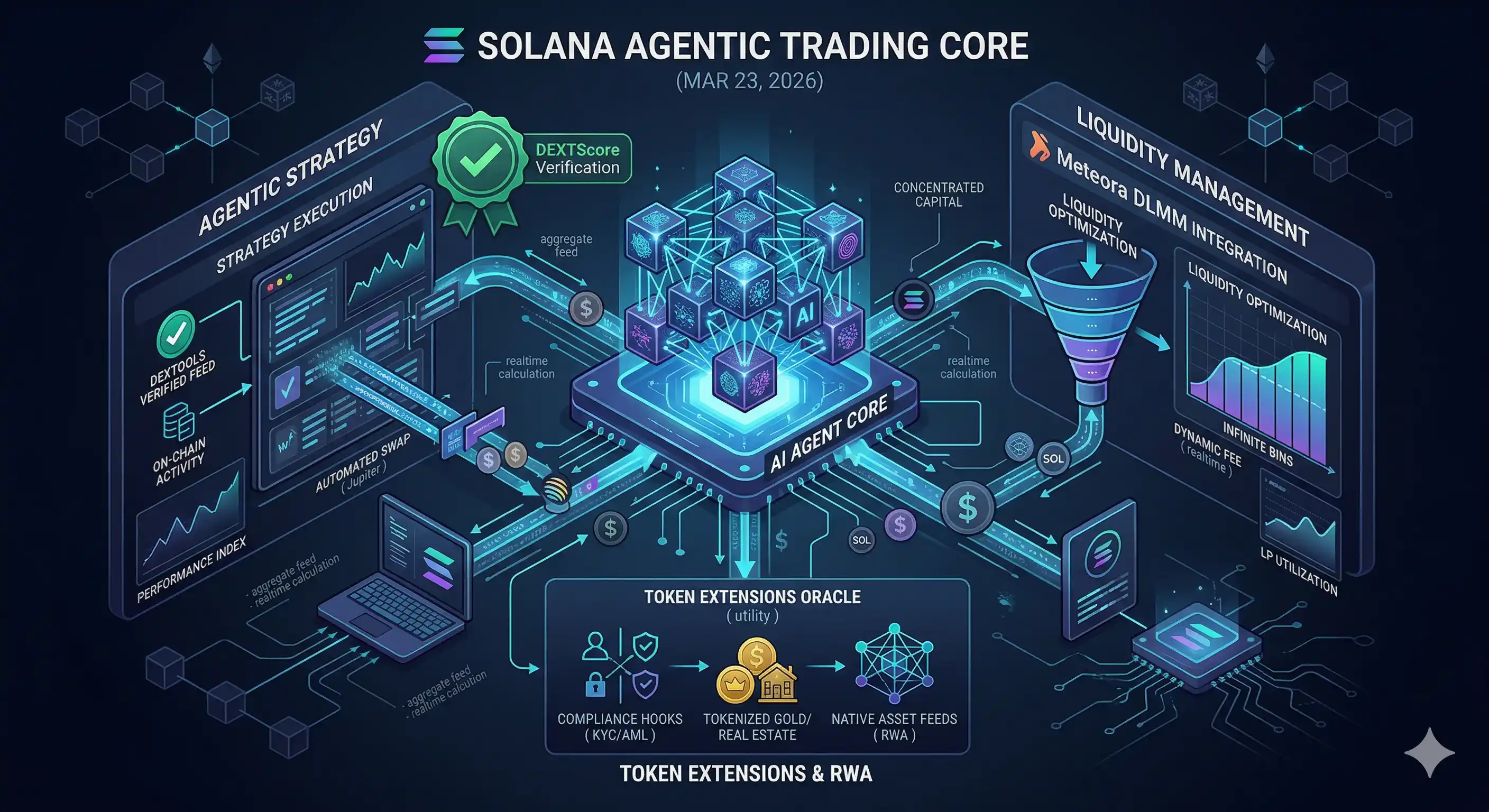
Execution occurs on Solana’s high-throughput network, which is critical for agentic infrastructure. AI agents operate in real-time, requiring low latency and minimal transaction costs to be economically viable. The network’s ability to handle high volumes of micro-transactions ensures that agents can perform frequent, small-value operations without eroding margins through fees. This economic utility is what distinguishes Solana’s agentic layer from traditional blockchain environments where transaction costs often prohibit autonomous machine-to-machine commerce.
This technical stack transforms Solana into a platform for the agentic internet. By providing robust tools for connection, context, and execution, the infrastructure supports a future where AI agents act as primary economic actors. The combination of open-source tooling and high-performance execution creates a fertile environment for the development of sophisticated autonomous systems.
Top AI agent use cases on Solana
The Solana Foundation is actively developing the network as key infrastructure for the "agentic internet," a model that shifts economic activity to AI agents instead of humans. This architecture supports autonomous execution at scale, evidenced by the network processing approximately 15 million blockchain payments initiated by AI agents as of early 2026.
These agents operate across three primary verticals: automated trading, portfolio management, and decentralized payments. Each use case leverages Solana's high throughput and low latency to execute strategies that would be impossible for human operators to manage manually.
Algorithmic Trading
Autonomous trading agents execute high-frequency strategies by analyzing on-chain data and market signals in real-time. Unlike traditional bots that follow static rules, these agents adapt to volatility, allowing for rapid entry and exit positions across multiple decentralized exchanges. This capability is critical for capturing arbitrage opportunities that exist for only milliseconds.
Autonomous Portfolio Management
AI-driven portfolio managers, such as Milo, operate their own smart wallets to rebalance assets based on predefined risk parameters. These agents monitor market conditions 24/7, automatically adjusting allocations to minimize drawdowns or capitalize on trending assets. This level of continuous oversight ensures that capital is always aligned with the agent's strategic objectives without requiring manual intervention.
Decentralized Payments
The most tangible metric of agentic utility is the volume of autonomous transactions. AI agents initiate payments for services, data access, and computational resources without human prompting. The 15 million payments processed on Solana demonstrate that this is not merely a speculative concept but a functioning economic layer where machines transact with machines.
Human-Led vs. AI-Led DeFi Actions
| Feature | Human-Led DeFi | AI Agent-Led DeFi |
|---|---|---|
| Execution Speed | Minutes to Hours | Milliseconds |
| Operational Cost | Gas + Slippage | Minimal Gas |
| Frequency | Discrete Events | Continuous |
| Emotional Bias | High | None |
Sol Price Implications for 2026
The transition from experimental AI deployments to full-scale agentic infrastructure directly alters Solana’s economic velocity. As the network processes approximately 15 million blockchain payments initiated by AI agents, the demand for SOL shifts from speculative holding to operational necessity. This volume is not merely a metric of activity; it is a driver of fee burn and staking yield, reinforcing the token’s utility in a high-frequency economy.
Current market valuation for SOL reflects this underlying shift. The PriceWidget above provides real-time context, but the structural bull case rests on the sustained volume of machine-to-machine transactions. Unlike human-driven trading, which can be sporadic, AI agents operate continuously, creating a baseline demand for block space that is less sensitive to short-term market sentiment.
This infrastructure layer requires significant capital efficiency. With 15 million agent-initiated transactions already recorded, the network demonstrates that the economic model can support high-throughput, low-latency payments at scale. For 2026, the price implication is tied to the expansion of this agent network. As more enterprises deploy autonomous agents for supply chain, finance, and data verification, the need for native SOL to settle these micro-transactions becomes a permanent fixture of the Solana economy.
Security and governance risks
Autonomous agents introduce attack vectors that static smart contracts do not face. The primary risk lies in key management and the potential for compromised decision-making logic. If an agent’s private keys are exposed or its prompt injection defenses fail, the resulting financial loss is immediate and irreversible. Unlike human operators, agents cannot pause for due diligence when a transaction looks anomalous.
To mitigate these risks, developers are turning to policy-controlled custody solutions. For instance, Helius outlines how integrating Turnkey allows agents to access Solana wallets while enforcing strict transaction policies. This ensures that even if an agent’s AI model is tricked, it cannot execute unauthorized transfers outside its predefined boundaries. Such governance layers are essential for scaling the network’s current volume of approximately 15 million AI-initiated payments.
Failure modes often stem from over-permissioned accounts rather than protocol bugs. A robust security posture requires least-privilege access, where agents only control the assets necessary for their specific tasks. As the Solana Foundation positions the network as the infrastructure for the agentic internet, these security protocols will determine whether autonomous economic activity remains viable or becomes a liability.
Will AI agents use Solana?
The evidence suggests Solana is becoming the default settlement layer for autonomous AI agents. The network has processed approximately 15 million blockchain payments initiated by AI agents, demonstrating that agentic infrastructure is no longer theoretical but actively in use.
This volume signals a shift in economic activity from human-driven transactions to machine-to-machine settlements. Solana's high throughput and low latency provide the necessary utility for agents executing micro-transactions at scale. The infrastructure is built to handle the density of agentic workloads without the friction common in other networks.
No comments yet. Be the first to share your thoughts!