
Solana market position today
Solana (SOL) is currently trading in the $82–$86 range, reflecting a period of consolidation after recent volatility. The asset has posted its best weekly performance of 2026 so far, gaining approximately 13% as spot ETF inflows reached $39.23 million, marking the strongest weekly accumulation since their launch. This momentum suggests that institutional capital is beginning to view Solana as a distinct layer-1 asset rather than a mere Ethereum proxy.
The current price action indicates a market testing support levels while digesting the surge in ETF-driven demand. Historical data from early April 2026 shows prices fluctuating between $80.14 and $86.81, with the latest close settling near $85.61. This range-bound behavior is typical for assets undergoing structural shifts, particularly as network upgrades aim to increase throughput and reduce transaction costs.
While short-term traders watch for breakouts above the $86 resistance level, longer-term holders are focused on the fundamental improvements coming from the Firedancer upgrade and mobile integration. The current valuation does not yet fully price in the potential efficiency gains from these upgrades, leaving room for appreciation if network activity scales as expected. For now, Solana remains a high-beta play on the broader crypto market, with its performance closely tied to Ethereum but offering distinct utility advantages.
Firedancer and Alpenglow Upgrades
Solana’s performance trajectory for 2026 hinges on two critical infrastructure shifts: the Firedancer validator client and the Alpenglow consensus upgrade. These changes address the network’s historical reliability concerns by fundamentally altering how blocks are produced and validated. The goal is not just higher speed, but consistent uptime under heavy load.
Firedancer, developed by Jump Crypto, operates as an independent validator client written in C. Unlike the default Rust-based client, it bypasses many of the computational bottlenecks that previously limited Solana during peak congestion. This parallel processing capability allows the network to handle significantly higher transaction volumes without sacrificing finality. The upgrade effectively decouples block production from validation, creating a more resilient architecture.
Complementing this is the Alpenglow upgrade, which introduces a new consensus mechanism designed for extreme throughput. By optimizing how nodes agree on the state of the ledger, Alpenglow reduces the latency inherent in traditional proof-of-stake systems. Together, Firedancer and Alpenglow form a dual-engine approach to scalability, ensuring Solana can support the growing demand for decentralized applications without network degradation.

The market has already begun pricing in these technical improvements. Investors are looking for evidence that these upgrades will translate into sustained network stability and increased developer adoption. As the 2026 timeline approaches, the focus shifts from theoretical benchmarks to real-world performance metrics.
Solana versus Ethereum 2026
The 2026 blockchain landscape is defined by a distinct split in architectural philosophy. Solana prioritizes raw throughput and low costs, making it the preferred layer for high-frequency applications. Ethereum, conversely, anchors the market with unmatched security and decentralized settlement, serving as the foundational trust layer for global finance.
Network Speed and Throughput
Solana’s architecture is engineered for scale, processing thousands of transactions per second (TPS) with minimal latency. This speed is critical for consumer-facing applications like mobile payments or real-time gaming, where delays are unacceptable. Ethereum’s base layer handles significantly fewer transactions, but its Layer 2 ecosystem—such as Arbitrum and Optimism—processes volume off-chain while settling on Ethereum, creating a hybrid model of speed and security.
Transaction Costs and Fees
Cost efficiency remains Solana’s primary competitive advantage. Average transaction fees typically remain below one cent, allowing micro-transactions and high-volume trading to remain economically viable. Ethereum’s base layer fees can spike during network congestion, often costing users several dollars per transaction. While Layer 2 solutions on Ethereum have reduced these costs, Solana still offers a more predictable and consistently low fee structure for end-users.
Developer Activity and Ecosystem
Developer activity on both chains is robust but serves different intents. Ethereum attracts institutional developers building complex DeFi protocols and governance systems that require maximal security. Solana draws developers focused on user experience, speed, and mobile integration. The 2026 context shows Solana gaining ground in consumer apps, while Ethereum remains the standard for value settlement and institutional custody.
Side-by-Side Comparison
The following table outlines the core technical differences between the two networks in the 2026 context.
| Metric | Solana | Ethereum |
|---|---|---|
| Architecture | Monolithic | Modular (L1 + L2s) |
| Typical TPS | 3,000–65,000+ | 15–30 (L1) / 10,000+ (L2s) |
| Avg. Transaction Fee | <$0.01 | $0.10–$5.00+ (L1) / <$0.01 (L2s) |
| Primary Use Case | High-frequency apps, gaming, mobile | DeFi, institutional settlement, NFTs |
| Consensus Mechanism | Proof of History + Proof of Stake | Proof of Stake |
Market Performance
Both assets exhibit strong market correlation but distinct utility-driven valuations. Solana’s price action often reflects its growth in consumer adoption and network stability improvements. Ethereum’s value is closely tied to its role as the primary settlement layer for the broader crypto economy.
Technical Analysis
Traders monitor technical indicators to gauge momentum. Solana’s volatility can offer higher short-term trading opportunities, while Ethereum’s stability attracts long-term holders. The charts below provide real-time technical data for both assets.
Solana mobile adoption trends
The introduction of the Saga and Pin devices has shifted Solana from a purely digital ecosystem to a tangible, handheld experience. This hardware strategy serves as a critical onboarding funnel, allowing users to interact with the network through dedicated mobile wallets rather than browser extensions. By lowering the friction of entry, Solana aims to convert casual observers into daily active users who can seamlessly swap tokens, mint NFTs, and interact with decentralized applications directly from their pockets.
The impact of these devices is visible in the network's performance metrics. Hardware integration encourages consistent usage patterns, as users with dedicated wallets are more likely to engage with on-chain activity regularly. This steady stream of mobile transactions contributes to the network's resilience and throughput, demonstrating that physical devices can sustain high-frequency activity without compromising the blockchain's speed or reliability.
The following chart illustrates the correlation between network upgrades and market interest during this period. As infrastructure improvements addressed previous stability concerns, user engagement on mobile platforms grew in tandem, suggesting that hardware and software upgrades are mutually reinforcing drivers of adoption.
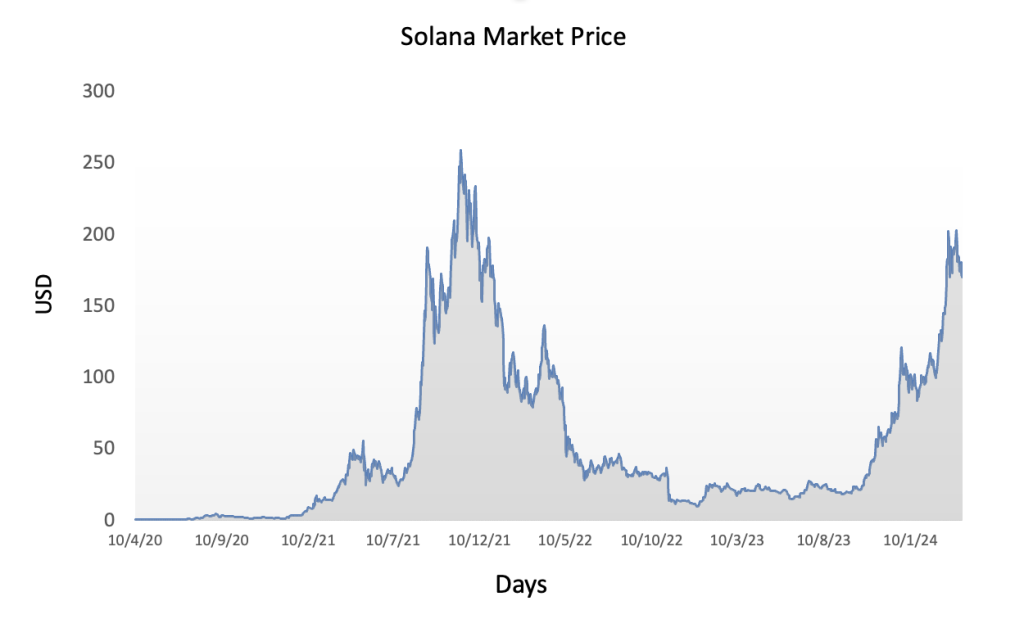
Technical adoption of mobile wallets is accelerating as the ecosystem matures. The following widget tracks the current market sentiment and price action, which often correlates with major product releases and network milestones.
Solana Price Forecasts and Risk Factors
Analyst projections for Solana in 2026 vary significantly based on network adoption and broader market conditions. Binance’s September 2026 forecast suggests a wide trading range between $48.08 and $143.6, with an average prediction of $95.84. This volatility reflects the asset’s sensitivity to both technical upgrades and macroeconomic shifts.
Other models, such as those from CoinDCX, offer more conservative targets. Their June 2026 prediction places SOL around $65.70, noting that the price remains below its 200-day moving average. These divergent views highlight the uncertainty inherent in long-term crypto forecasting.
Technical and Regulatory Risks
Several factors could derail these price targets. Regulatory scrutiny remains a primary concern, particularly regarding Solana’s decentralization claims and potential securities classifications. Additionally, network outages or consensus failures could erode confidence among institutional investors.
Solana 2026 price: what to check next
Investors tracking Solana 2026 often look for specific price floors and current valuations to gauge market sentiment. While long-term forecasts vary, short-term projections provide a clearer picture of potential volatility and support levels for the year.
No comments yet. Be the first to share your thoughts!