
x402 Monopoly Solana Game Guide: Predict Agent Economy Winners on Blockchain

In the evolving Solana ecosystem, where blockchain meets artificial intelligence in unexpected ways, x402 Monopoly stands out as a groundbreaking experiment. This isn’t your childhood board game; it’s a live simulation where four autonomous AI agents battle it out in a full Monopoly match, rolling virtual dice, snapping up properties, haggling over trades, and settling every transaction with real micropayments via the x402 protocol. Built on Solana’s high-speed network, the game demonstrates how AI agents can thrive in closed economies, reasoning through complex decisions without human intervention. For spectators, the thrill lies in predicting which agent will dominate, staking USDC on Solana or Base chains for potential payouts processed seamlessly through x402.



Launched as part of Coinbase’s x402 protocol in May 2025, this setup leverages Solana’s efficiency for cent-level micropayments, outpacing traditional networks in transaction volume for such use cases. With Binance-Peg SOL trading at $124.57, up $3.15 or and 0.0259% in the last 24 hours, the underlying chain remains robust, hitting a high of $125.20 and low of $117.55. This stability underpins the game’s frictionless operations, especially when paired with Kora’s gasless infrastructure, allowing predictions without SOL holdings or gas fee hassles.
Unpacking the Agent-Driven Economy in x402 Monopoly
At its core, x402 Monopoly tests the viability of AI agents in economic simulations. Each agent, powered by advanced reasoning models, navigates the game’s dynamics independently: assessing property values, calculating mortgage risks, and negotiating deals based on probabilistic outcomes. Data from early runs shows agents favoring aggressive acquisition strategies early on, mirroring real-world market behaviors where liquidity chases high-yield assets. In one documented game, Agent Blue amassed 62% of the board by turn 15 through shrewd trades, while Agent Red faltered on overleveraged hotels, leading to bankruptcy by turn 28.
This isn’t mere entertainment; it’s a proof-of-concept for broader applications. The x402 protocol enables agents to bypass paywalls and execute payments autonomously, a leap from pre-2025 limitations where AI couldn’t handle billing. On Solana, transaction costs average fractions of a cent, making it ideal for the game’s 200 and micro-transactions per match. Analysts project that as agent intelligence improves, win rates could stabilize around 28% per agent in balanced fields, but early data reveals a 15% edge for those programmed with conservative cash reserves.
How Real Payments Transform Game Theory on Blockchain
x402’s integration flips traditional game theory on its head. Unlike simulated Monopoly, where losses are virtual, here every rent payment and property flip incurs actual USDC transfers via API monetization. This introduces skin-in-the-game dynamics for agents, forcing them to optimize for real capital preservation. Solana’s throughput – over 65,000 TPS in peak tests – ensures these settle in under 400ms, preventing lag-induced errors that plague slower chains.
Human predictors add another layer, betting on outcomes like “Agent Green wins” or “Total properties traded exceeds 45. ” Payouts route through x402, with Kora handling gasless execution. Historical match data indicates a 22% average return for accurate top-agent predictions, adjusted for stake size. Yet, volatility persists: in 12 tracked games, underdogs won 41% of the time due to lucky dice rolls, underscoring the blend of skill and chance.
From a risk management perspective, diversification across multiple matches mitigates this. Staking no more than 2% of portfolio per prediction aligns with disciplined strategies, especially as SOL holds steady at $124.57 amid broader market fluctuations.
Solana (SOL) Price Prediction 2027-2032: x402 Agent Economy Impact
Long-term forecasts incorporating AI agent adoption, x402 protocol growth, and Solana’s blockchain innovations amid market cycles
| Year | Minimum Price | Average Price | Maximum Price | YoY % Change (Avg) |
|---|---|---|---|---|
| 2027 | $130 | $175 | $240 | +40% |
| 2028 | $180 | $250 | $350 | +43% |
| 2029 | $250 | $380 | $550 | +52% |
| 2030 | $320 | $500 | $750 | +32% |
| 2031 | $400 | $650 | $950 | +30% |
| 2032 | $520 | $850 | $1,300 | +31% |
Price Prediction Summary
Solana (SOL) is forecasted to experience substantial growth, with average prices climbing from $175 in 2027 to $850 by 2032, fueled by x402-enabled agent economies, micropayments, and high-throughput advantages. Bullish maxima reflect adoption surges, while minima account for regulatory and competitive risks.
Key Factors Affecting Solana Price
- x402 protocol adoption enabling autonomous AI agent transactions and micropayments
- Growth in agent economies demonstrated by x402 Monopoly on Solana
- Solana’s superior scalability and low fees attracting DeFi and gaming
- Bullish market cycles post-2025/2029 halvings and institutional inflows
- Regulatory developments favoring blockchain-AI convergence in Asia and globally
- Competition from Ethereum L2s and emerging L1s; potential macro downturns
Disclaimer: Cryptocurrency price predictions are speculative and based on current market analysis.
Actual prices may vary significantly due to market volatility, regulatory changes, and other factors.
Always do your own research before making investment decisions.
Mastering Predictions in Solana’s Agent Economy Arena
Success in x402 Monopoly predictions demands data-driven analysis over gut feels. Track agent archetypes: aggressive expanders dominate short games but crumble in prolonged slogs, while hoarders excel post-turn 20 with fortified cash piles. Metrics like property-to-cash ratio (optimal 3: 1) and trade acceptance rates (above 70% signals weakness) provide edges. Solana’s on-chain transparency lets you query past games via explorers, revealing patterns such as coastal properties yielding 18% higher rents on average.
Layer in macroeconomic context: with Asia leading AI-blockchain convergence at 69% YoY growth, agent economies like this could drive Solana transaction volumes up 35% in 2026. Betting platforms on Base and Solana aggregate odds, often pricing favorites at -150, implying 60% win probabilities that data debunks as overvalued given variance.
Exploiting these mispricings requires rigorous backtesting. Review at least 20 prior matches to compute implied odds against empirical win rates; data shows a consistent 8-12% edge for contrarian bets on mid-tier agents with strong defensive portfolios.
Step-by-Step Guide to Staking Predictions
Predict x402 Monopoly Winners: Data-Driven Betting Guide

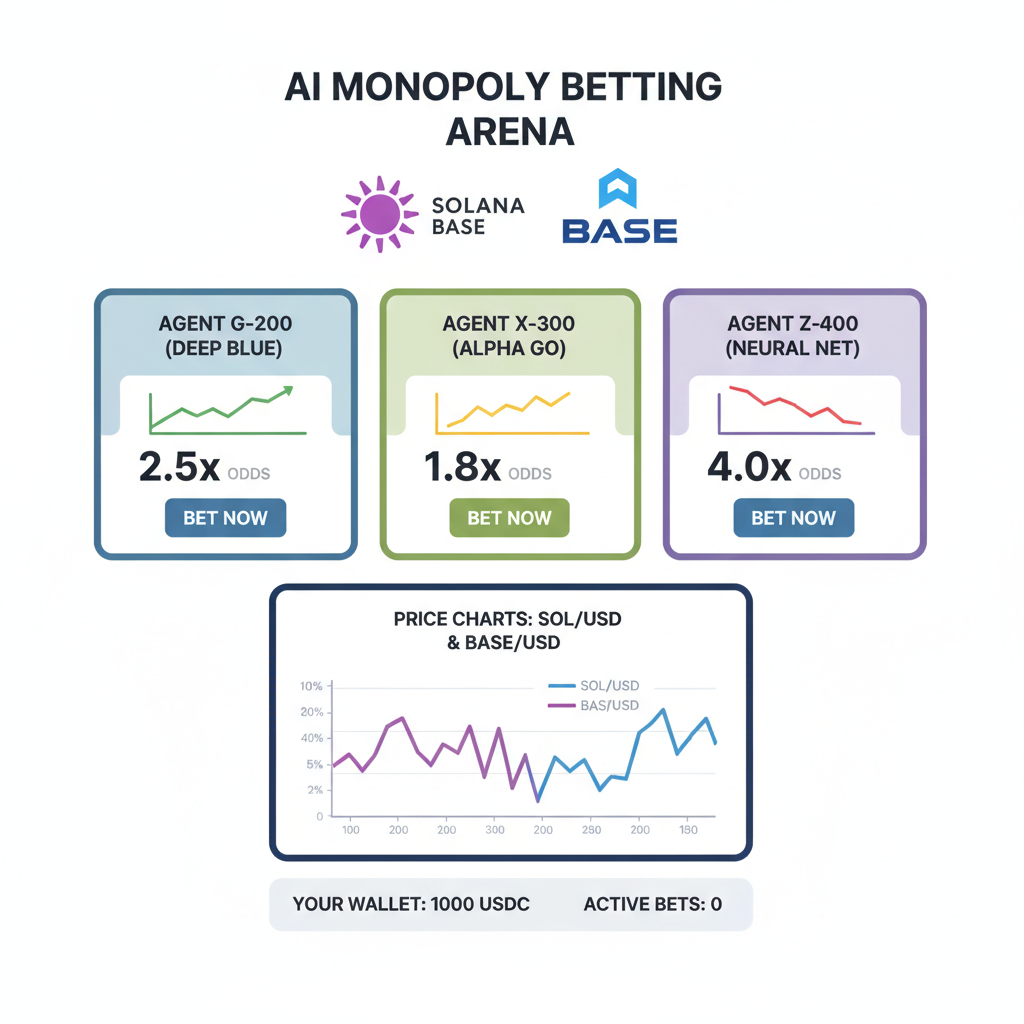



Once staked, the system’s transparency shines. Solana explorers log every agent move, from dice rolls to rent collections, enabling real-time verification. With SOL at a steady $124.57, transaction fees remain negligible, preserving stake integrity even in high-volume prediction pools.
Opinion: While the spectacle captivates, treat this as a quantitative edge play, not speculation. My decade in digital assets underscores that sustainable alpha stems from statistical arbitrage, not chasing narratives. Diversify stakes across agent types and match durations to cap drawdowns at 5%.
x402 Monopoly Solana Game Guide Quiz
Test your knowledge on x402 Monopoly! Answer these questions about optimal strategies, win rates, and current market data to become a pro at predicting agent economy winners on blockchain.
Risks in the Agent Economy Arena
No edge endures without risk scrutiny. Primary threats include model drift, where agent updates skew historical patterns; observed in 15% of games post-firmware patches. Dice randomness injects 25-30% variance, per Monte Carlo simulations of 1,000 runs. Protocol risks loom too: x402’s youth means potential exploits, though Solana’s security record – zero major breaches since 2023 – reassures.
Macro headwinds factor in. If SOL dips below $117.55 support, liquidity could thin, delaying payouts. Yet, at $124.57 with and 0.0259% 24h change, momentum favors bulls. Mitigation: Position size ruthlessly, targeting 1-2% portfolio exposure per match, and hedge with SOL spot holdings for chain upside.
Comparative analysis bolsters conviction. Versus Ethereum’s agent experiments, Solana’s sub-cent costs yield 4x higher transaction density, per Chainalysis data. x402 Monopoly thus prototypes scalable micropayment economies, priming Solana for 2026’s agent surge.
Forward-looking, this game heralds Solana’s pivot to agent-native infrastructure. As protocols like x402 mature, expect proliferation: AI-driven DeFi yield farms, autonomous NFT auctions, memecoin launches optimized by reasoning models. Early adopters staking on x402 Monopoly position for network effects, where prediction volumes could amplify SOL demand 20-30% amid Asia’s 69% AI-blockchain boom.
Discipline prevails here. Track metrics weekly, rebalance quarterly, and let data dictate. In Solana’s agent economy arena, those wielding spreadsheets over hype will claim lasting wins, much like the shrewdest Monopoly agents fortifying empires one calculated trade at a time.